
Church and Religious Building Roofing in Chattanooga, TN
Church and Religious Building Roofing starts with roof evidence before repair, restoration, recover, or replacement decisions are made.
Roof Work
Document the roof before choosing the scope
Commercial roofing for churches, worship centers, and religious facilities throughout Chattanooga, TN.
First Presbyterian Church of Chattanooga, established in near the Tennessee River bend, anchors the historic ecclesiastical heritage of a city that has seen extraordinary growth and investment over the past two decades. Chattanooga sits at the convergence of four mountain ridges where Lookout Mountain, Signal Mountain, Missionary Ridge, and the Cumberland Plateau create a compressed topography that channels weather systems into the valley floor with unusual intensity. Understanding how the Tennessee River corridor funnels moisture, generates localized convective storms, and experiences dramatically different microclimates between ridge and valley is foundational knowledge for any commercial roofer working on Chattanooga's houses of worship.
The ridge-valley geography of the Chattanooga basin creates precipitation patterns that differ measurably across a few miles. The downtown valley floor where most of Chattanooga's historic churches sit receives more rainfall than the ridge communities above, with storm drainage events that can overwhelm older church drainage systems designed when the surrounding watershed was less developed and roof runoff was more predictable. June through September brings afternoon convective thunderstorms with intense short-duration rainfall, and the region's position in Dixie Alley means tornado watches and severe wind events are regular features of spring and early summer weather. Church roofs must be designed and maintained to handle both the sustained moisture load of a wet valley environment and the episodic violence of severe storms.
First Presbyterian's McCallie Avenue campus includes a sanctuary with a broad gabled roof and attached educational wings that span different construction eras, a common profile for large urban Tennessee congregations that grew incrementally through the twentieth century. Each building addition brings a different roofing system, different slope profiles, and different drainage logic, creating the complex valley and flashings intersections that are the most frequent source of long-term water intrusion in layered institutional campuses. Experienced Chattanooga contractors treat each campus section as a separate scope during initial assessment, mapping drainage pathways across the entire campus before recommending system replacements in any individual section.
Capital campaign timing in Chattanooga's Presbyterian and Methodist congregations follows national denominational patterns, but local economic conditions matter as well. Chattanooga's transformation from a struggling post-industrial city to a tech-forward destination since the 2010s has expanded the philanthropic capacity of many congregations whose membership has grown with the broader economic revival. Contractors who entered the Chattanooga church market during the revitalization period have seen capital project budgets grow substantially, and congregations that might have deferred a roofing project for five years a decade ago may now have the donor capacity to act on a phased program within two budget cycles.
Summer scheduling in Chattanooga is shaped by the heat. The valley floor in July and August routinely registers heat indices of 100 to 105°F, and rooftop temperatures on dark membrane systems can reach 170°F or higher during peak afternoon hours. Contractors managing roofing crews under these conditions must implement mandatory OSHA heat illness prevention protocols, shift start times to 6:00 AM, and schedule the most physically demanding work for the first three hours of the day. Congregations working with experienced contractors appreciate seeing these safety programs documented, as a worker medical emergency on a church campus creates pastoral as well as operational complications that church administrators want to avoid.
Denominational considerations in Chattanooga include oversight from the Presbyterian Church USA's Presbytery of East Tennessee, the United Methodist Church's Tennessee Conference, and the Roman Catholic Diocese of Knoxville, which has jurisdiction over Chattanooga's Catholic parishes. Hamilton County's mix of historic mainline congregations and rapidly growing nondenominational megachurches, including Abba's House and Redemption Church, creates a market with very different governance structures on adjacent streets. Contractors must be able to adapt their sales and proposal processes to serve both a 190-year-old Presbyterian congregation with a detailed governance structure and a contemporary campus operated by a streamlined executive team.
Committee decisions at Chattanooga's established congregations are often led by dedicated building and grounds committees with members who have served for years and have long institutional memories of past roofing projects, both positive and negative. These experienced lay leaders ask detailed questions about warranty terms, manufacturer relationships, and installer certifications. Contractors who hold manufacturer's certified contractor status and can demonstrate direct accountability to warranty programs consistently outperform general commercial contractors who cannot articulate these relationships. The Church of God denomination, headquartered in nearby Cleveland, Tennessee, also has member congregations throughout Hamilton County that follow denominational facilities guidelines the contractor should understand.
Tennessee building code requires commercial roofing permits in Hamilton County, and Chattanooga's position in a moderate seismic zone, rated Zone 1 to Zone 2 depending on specific location, means that roofing contractors should verify that any roof-mounted equipment additions are braced to seismic requirements appropriate for the New Madrid Seismic Zone's long tail into east Tennessee. While this consideration rarely affects membrane replacement projects directly, it is relevant when congregations add HVAC units or solar arrays to existing roofs as part of a broader facilities upgrade coordinated with re-roofing.
Maintenance relationships in Chattanooga's church market benefit from the city's compact geography. Most of the major historic congregation campuses are within five miles of each other in the urban core, making regular inspection routes efficient for contractors who serve multiple faith community clients. Annual spring inspections after Tennessee's severe weather season and fall inspections before winter moisture events represent the minimum effective maintenance cycle, with post-storm response protocols that contractors should clearly communicate in their service agreements.
What information should we send before a Church and Religious Building Roofing roof walk?
Before a Church and Religious Building Roofing roof walk, send the building location, roof age if known, roof access instructions, leak photos, tenant restrictions, and prior roof reports. Those details let us shape the inspection around the actual roof problem instead of arriving with a generic checklist.
Can Church and Religious Building Roofing be handled while the building stays occupied?
For Church and Religious Building Roofing, occupied-building work depends on access, odor, noise, staging room, weather exposure, and how much roof must be opened at one time. We phase the work around dry-in, tenant protection, loading paths, and the operating schedule below the roof.
How do we compare repair, coating, recover, and replacement for Church and Religious Building Roofing?
For Church and Religious Building Roofing, we compare moisture evidence, layer count, deck condition, drainage, age, storm exposure, roof traffic, and future use before naming a scope. That evidence is what separates a repair file from a restoration plan, a recover option, or a replacement budget.
Do you promise manufacturer certification or insurance approval for Church and Religious Building Roofing?
For Church and Religious Building Roofing, we do not invent credentials, promise claim outcomes, or write warranty language before the facts support it. We document conditions, identify manufacturer or carrier questions, and keep recommendations tied to reviewable roof evidence.
What makes Chattanooga planning different for Church and Religious Building Roofing?
Chattanooga planning for Church and Religious Building Roofing has to account for downtown access, UTC and hospital-area traffic, Enterprise South and Centre South Riverport industrial corridors, humid Tennessee Valley heat, severe thunderstorms, hail, freeze-thaw movement, leaf debris, and wind-driven rain.
- University Campus Roofing
- PVC Commercial Roofing
- Roof Tear Off Replacement
- Emergency Tarp Dry
- Manufacturing Facility Roofing
- Occupied Building Reroofing
- New Construction Roofing
- Insulation Recovery Board
Planning checkpoints
From urgent response to responsible scope
Condition
Church and Religious Building Roofing work starts with the affected roof area, water path, membrane condition, and interior evidence.
Operations
Work windows, tenant protection, loading paths, and safety expectations need to be named early.
Options
Repair, maintenance, coating, recover, and replacement should be compared without blurring the tradeoffs.
Next Step
A concise field record helps ownership decide what needs immediate action and what belongs in planning.
Related roof paths
Keep exploring
 Roof Work
University and College Campus Roofing
University and College Campus Roofing support covers access, staging, drainage, and roof traffic for Chattanooga commercial buildings.
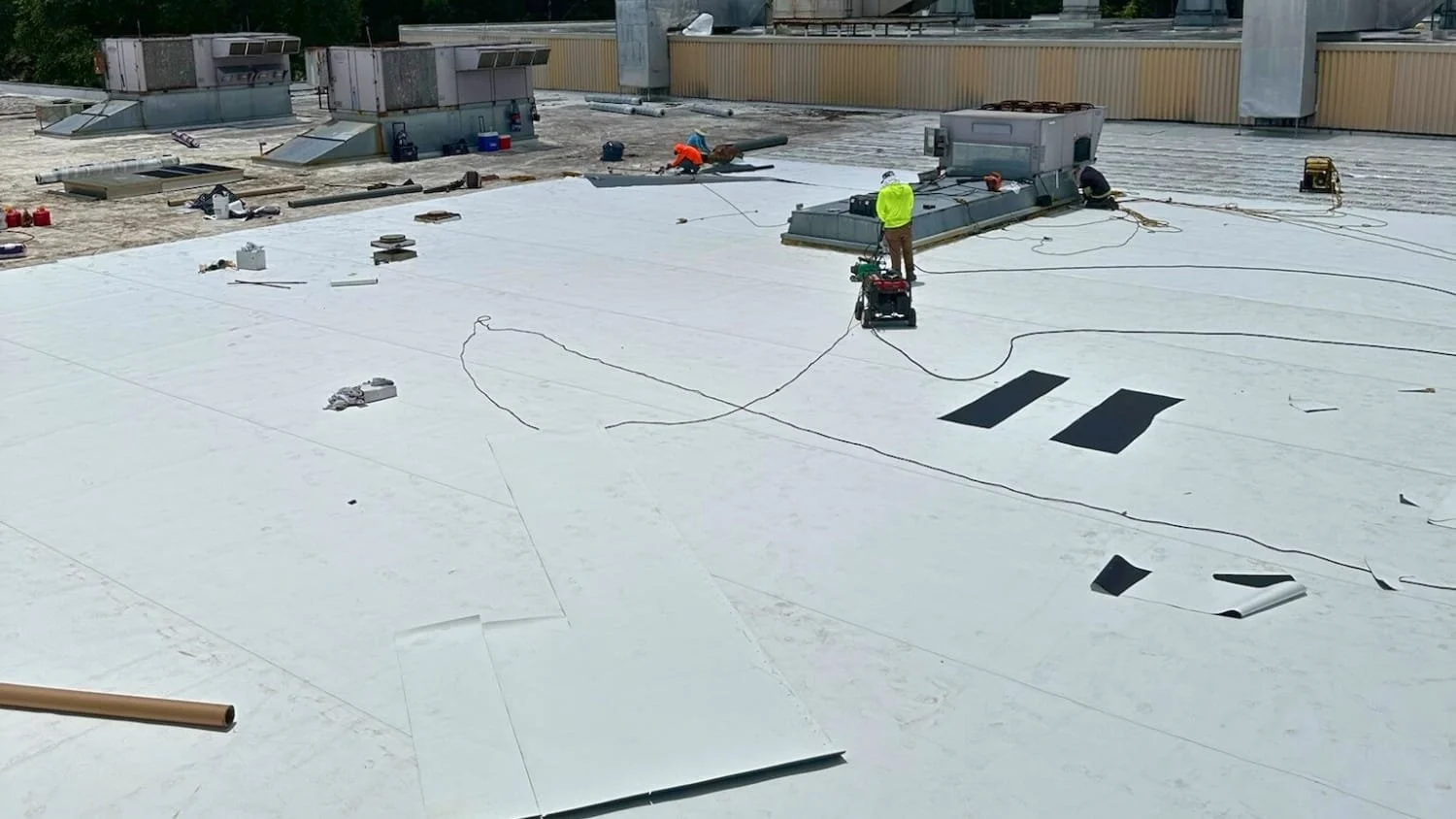 Roof Work
PVC Commercial Roofing
PVC Commercial Roofing support covers tenant communication, rooftop equipment, and dry-in timing for Chattanooga commercial buildings.
 Roof Work
Roof Tear-Off and Replacement
Roof Tear-Off and Replacement support covers moisture review, edge conditions, and practical budget timing for Chattanooga commercial buildings.